

TL;DR: The fix for co-founder resentment is not a better relationship. It is a written map of who owns which function, who makes the final call when functions collide, and a date on the calendar to redraw that map as the company changes shape.
Two co-founders can agree completely on the product vision and still end up on opposite sides of a tense dinner a year later, because they never agreed on who owns the number when the sales forecast misses. That gap, not personality, is the thing you can actually manage before it gets expensive. The call that matters is not who is smarter. It is which function each of you owns, and who breaks the tie when those functions collide.
Why vague role division quietly breeds resentment
A seed-stage company with two co-founders and $2M raised can run fourteen months on goodwill alone. The technical co-founder builds, the commercial co-founder sells, and nobody writes down who owns pricing.
It works until a $40k deal needs a discount to close. The commercial co-founder wants to say yes. The technical co-founder thinks margin is a product decision and says no in a Slack thread, in front of the team. Neither one knew the other believed they owned that call.
Resentment rarely starts as a single blowup. It accumulates in small moments like that one. By month eight, the two of you are not fighting about pricing anymore. You are fighting about whether your partner respects your judgment.
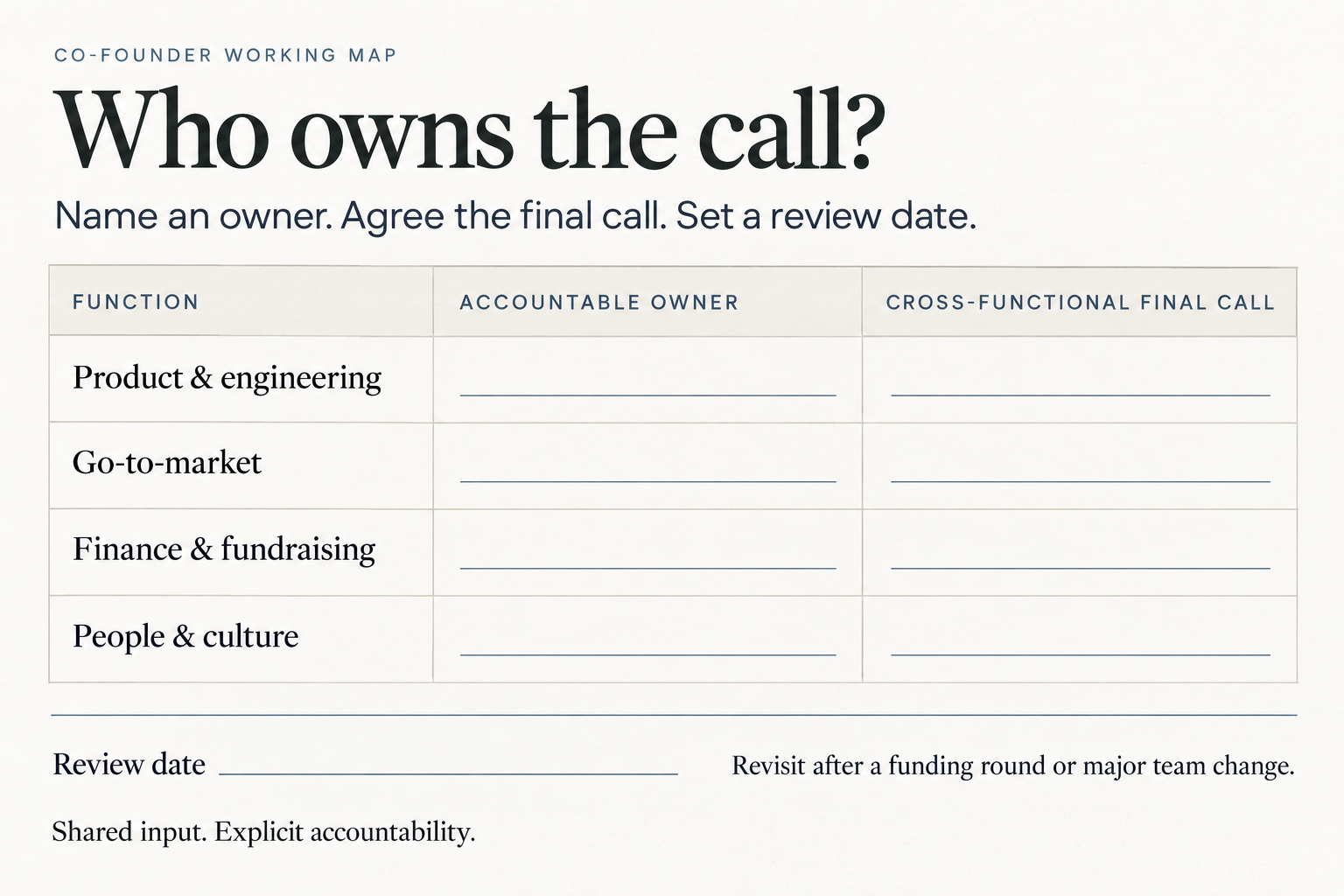 A role map on paper settles more disputes than another late-night conversation.
Decision one: map each founder's strength to a functional domain
The instinct at founding is to split everything fifty-fifty, because that feels fair. It is also almost never how the company actually runs. At a twelve-person company that has raised a $6M Series A, the real split is rarely symmetric: one co-founder lives in investor meetings and the board deck, the other lives in sprint planning and the on-call rotation. Naming that split early beats pretending both of you are equally load-bearing on every function.
A working map usually covers four domains:
- Product and engineering. One founder owns the roadmap and technical tradeoffs, and ships the call even when the other disagrees.
- Go-to-market. The other owns pricing, the sales motion, and the message, with the same final say.
- Finance and fundraising. Sits with whoever actually spends the time with the board and the cap table, named explicitly rather than assumed.
- People and culture. Often shared, but even shared ownership needs one name attached to hiring decisions that have to move fast.
The map does not need to be even. It needs to match who actually has the judgment and appetite for each domain, written down where both of you can point to it later.
Decision two: set decision rights for cross-functional calls
The map handles decisions inside a domain. It does nothing for the ones that sit between domains, and those cause the most damage, because both founders have a legitimate claim to weigh in.
A pricing concession is a GTM call and a margin call. A key hire's title is a people call and a fundraising signal. Somebody has to own the tiebreak before the moment arrives, not during it.
Two models handle this, and they are not interchangeable.
| Consensus on every cross-functional call | Domain owner decides, partner can flag | |
|---|---|---|
| Speed | Slow by design; every call waits for both founders | Fast; the owner moves without waiting for sign-off |
| Failure mode | Stalls when founders are in different cities or disagree quietly | Owner can miss something the other founder would have caught |
| What it requires | High trust and constant availability to each other | A clear map plus a habit of raising concerns early |
| Best fit | Two founders working side by side daily, pre-ten people | Past ten people, when founders are no longer in one room all day |
Most companies start in the left column by default and never consciously move to the right one, even once they have outgrown consensus. The founders who handle this well pick a model on purpose. The ones who struggle let the model drift with whoever is more persistent.
Decision three: revisit roles as the company changes stage
A role map built at eight people is not the map a forty-person company needs, even with the same two founders in the same seats. The co-founder who owned "sales" when that meant personally closing every deal does not automatically own "revenue" once there is a VP of Sales and a forecast built by someone else. Stage changes should trigger a role conversation the same way a board meeting or a fundraise does, not get discovered months late in a moment of friction. What actually changes at the Series A operating layer covers this shift from the company's side; the founder-pair side of it is the same conversation, just between two people instead of across an org chart.
Set a recurring check: every funding round, and at minimum once a year, redraw the map on purpose. Most of it will stay the same. The parts that do not are the parts that would otherwise fester.
When role clarity isn't enough and mediation is needed
A written map solves ambiguity. It does not solve two co-founders holding fundamentally different ideas about what company they are building, with the role fight just where that surfaces. If every cross-functional call turns into a rehash of who has real authority, the map is no longer the issue.
That is the harder conversation in co-founder conflict and when to split: fixable friction about process, or a fundamental disagreement about direction that no org chart resolves. The cost of waiting too long is not abstract. A co-founder who leaves without a resolved equity position is the quiet version of the failure every vesting schedule exists to prevent.
Before you finalize the next role split, sit with these
- Can you name, right now, who has final say on your three highest-stakes recurring decisions?
- Has your co-founder ever been surprised by a call you made in their domain?
- When was the last time you redrew the map, and did a funding round or headcount milestone happen since then?
- If you disagree on a cross-functional call next week, do you both already know whose call it is?
- Are you avoiding a role conversation because it might turn into a different one?
The pattern underneath
The founders who get this right treat the role map as a living document, something they expect to redraw as the company grows. The ones who struggle treat it as settled once, then act surprised when the map that fit two people in a garage no longer fits two people running a forty-person company.
Did the roles survive the first real crisis, or just the honeymoon.
If this is the decision in front of you, that is what VEN is for: small groups and 1:1 conversations with peers at your own level of experience, focused on the call you are carrying. Can we help? →